How this calorie calculator works
It works in two steps. First it estimates your basal metabolic rate (BMR), the calories your body burns at rest just to stay alive, using the Mifflin-St Jeor equation. Studies comparing equations against measured metabolism have found Mifflin-St Jeor to be the most accurate of the common formulas for most adults.
- Men: BMR = 10 × weight (kg) + 6.25 × height (cm) − 5 × age + 5
- Women: BMR = 10 × weight (kg) + 6.25 × height (cm) − 5 × age − 161
Then it multiplies BMR by an activity factor to get your total daily energy expenditure (TDEE), the calories you burn in a typical day. Eat that many and your weight should stay about the same.
Worked example
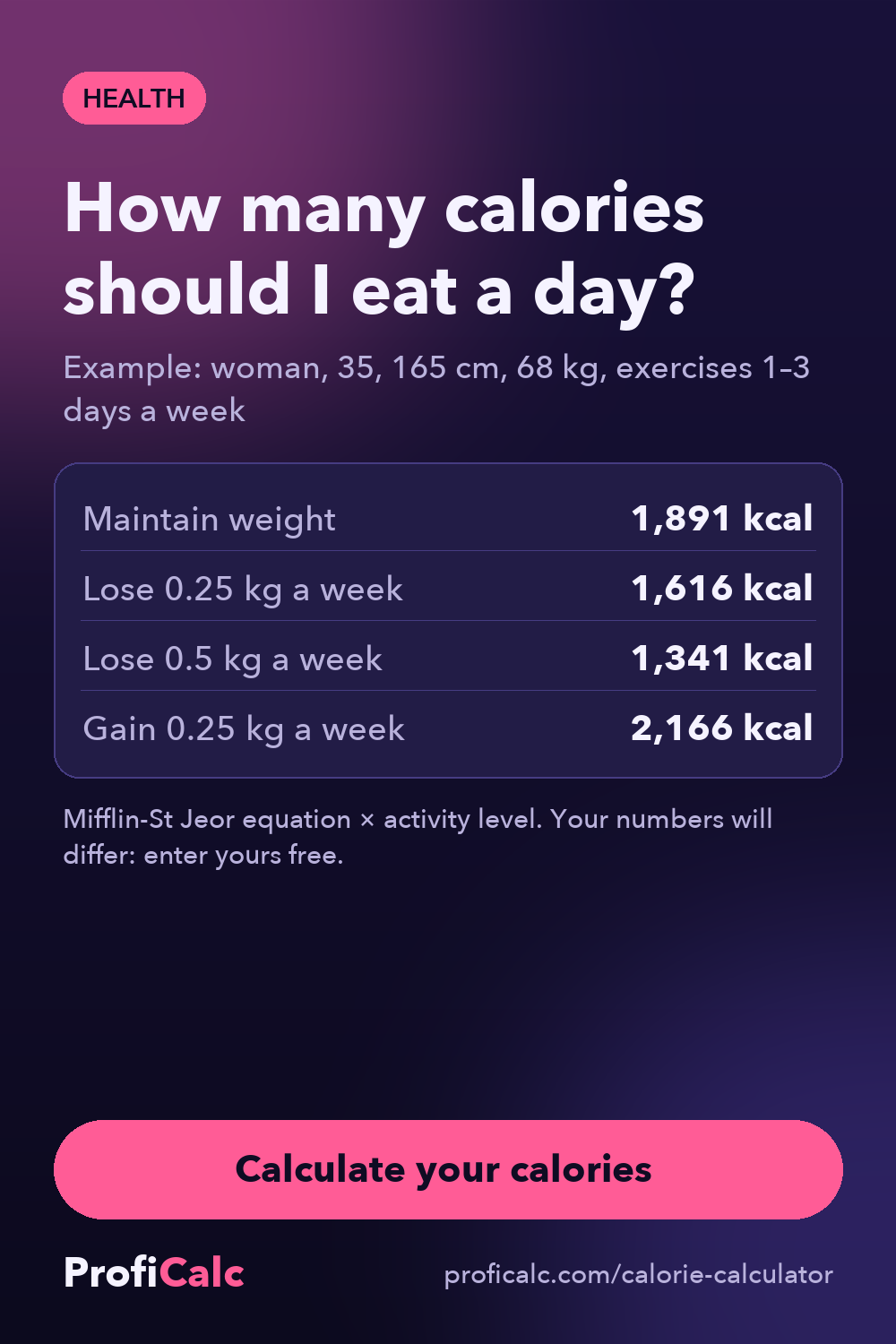
A 35-year-old woman, 165 cm tall and weighing 68 kg, who exercises 1–3 days a week:
- BMR = 10 × 68 + 6.25 × 165 − 5 × 35 − 161 = 680 + 1,031 − 175 − 161 = 1,375 kcal
- TDEE = 1,375 × 1.375 = about 1,891 kcal a day to maintain her weight
- To lose about 0.5 kg a week: 1,891 − 550 = about 1,340 kcal a day
Activity levels explained
- Sedentary (× 1.2): desk job and little deliberate exercise.
- Light (× 1.375): walking or light workouts 1–3 days a week.
- Moderate (× 1.55): moderate exercise 3–5 days a week.
- Active (× 1.725): hard training most days.
- Very active (× 1.9): a physical job plus training, or twice-a-day sessions.
Most people overestimate their activity. If you're unsure, pick the level below the one you think fits.
How many calories to lose weight
A pound of body fat stores roughly 3,500 kcal and a kilogram roughly 7,700 kcal. So a daily deficit of about 500 kcal leads to losing around 1 lb (0.45 kg) a week. In practice weight loss slows over time, because a smaller body burns fewer calories and the body adapts. Health services such as the NHS and CDC suggest aiming for 0.5–1 kg (1–2 lb) a week at most.
Very low intakes make it hard to get enough protein, vitamins and minerals. Most guidelines suggest not going below about 1,200 kcal a day for women or 1,500 kcal for men without medical supervision, and the calculator warns you if a target falls below that.
Gaining weight or muscle
To build muscle with little fat gain, a small surplus of about 250–300 kcal a day plus strength training and enough protein works for most people. Bigger surpluses mostly add fat.
Why your real number may differ
Any formula is an average. Genetics, muscle mass, hormones, sleep and medications all change how many calories you burn, and people of the same size can differ by 10% or more. Use the result as a starting point: eat at the target for two to three weeks, weigh yourself a few times a week at the same time of day, and adjust by 100–200 kcal if the trend isn't what you expected.
This calculator gives general information only and is not medical advice. Talk to a doctor, midwife or registered dietitian about your own health.
Frequently asked questions
How many calories should I eat a day?
It depends on your size, age, sex and activity. Many adult women maintain their weight on about 1,800–2,400 kcal a day and many men on 2,200–3,000. Enter your details above for a personal estimate.
What is TDEE?
Total daily energy expenditure: all the calories you burn in a day, including your resting metabolism, digestion, daily movement and exercise. It's the number to eat to keep your weight stable.
How many calories should I eat to lose 1 kg a week?
About 1,100 kcal a day below your TDEE, since 1 kg of fat holds about 7,700 kcal. For many people that is too aggressive; 0.5 kg a week (a 550 kcal deficit) is easier to sustain.
Is 1,200 calories a day enough?
It's usually treated as the lowest safe intake for women without medical supervision. Most people lose weight on more than that, and very low intakes make it hard to get enough nutrients.
Which formula does this calculator use?
The Mifflin-St Jeor equation for resting metabolism, multiplied by a standard activity factor. It's the formula recommended by the Academy of Nutrition and Dietetics for estimating calorie needs in healthy adults.