How your due date is calculated
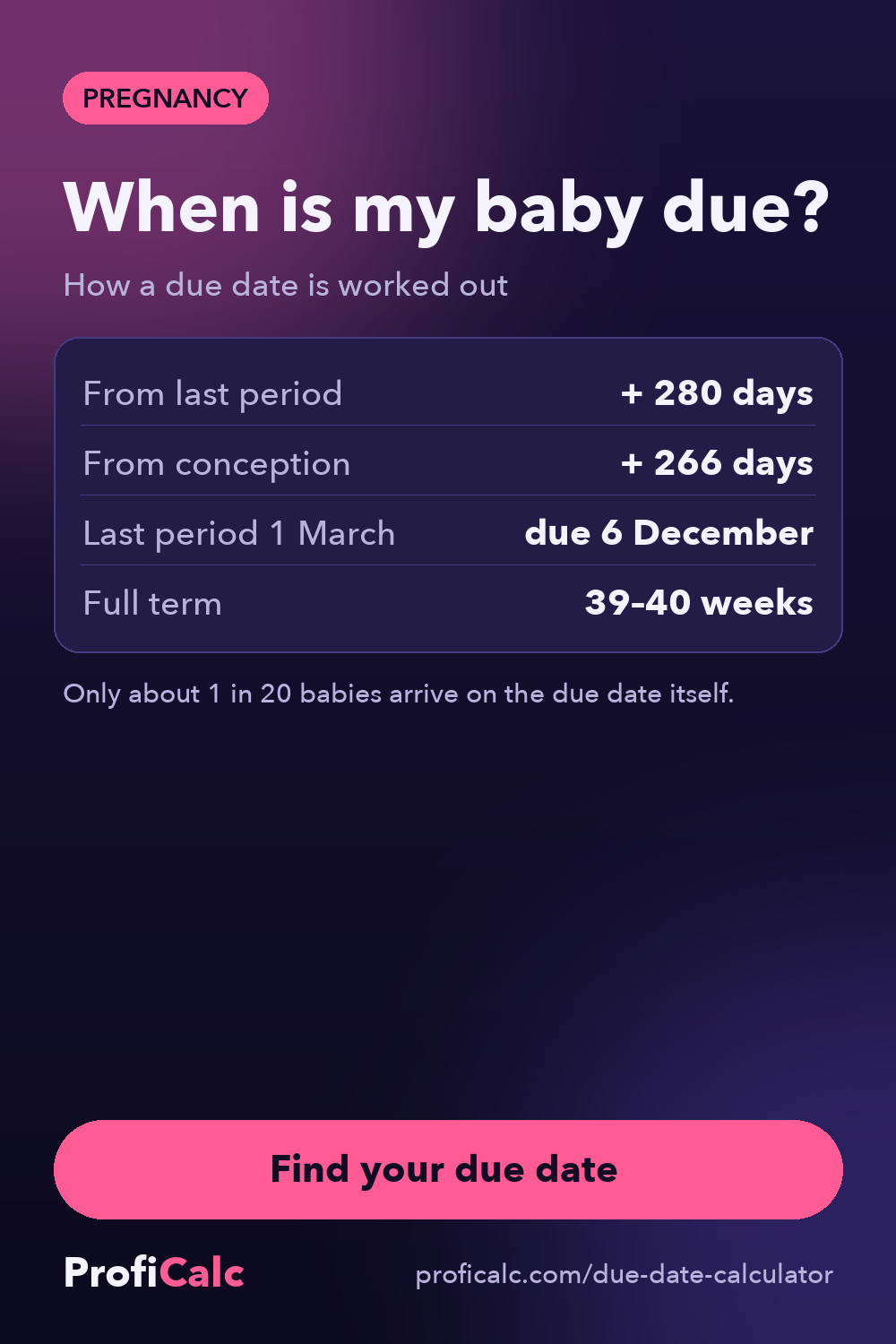
The standard method, called Naegele's rule, adds 280 days (40 weeks) to the first day of your last menstrual period (LMP). It assumes a 28-day cycle with ovulation on day 14. If your cycles are longer or shorter, the calculator moves the date by the difference: a 32-day cycle pushes the due date 4 days later.
- From your last period: LMP + 280 days (+ cycle length − 28)
- From conception: conception date + 266 days (38 weeks)
- From a 3-day IVF transfer: transfer date + 263 days
- From a 5-day (blastocyst) transfer: transfer date + 261 days
Worked example
If your last period started on 1 March with a regular 28-day cycle, add 280 days: your estimated due date is 6 December. Conception most likely happened around 15 March.
Why pregnancy is counted from your period
Doctors count "gestational age" from the first day of your last period, about two weeks before conception, because that date is easier to know. So at the moment of conception you are already considered about two weeks pregnant. A full-term pregnancy is about 40 weeks from LMP, or 38 weeks from conception.
The trimesters
- First trimester (weeks 1–13): the baby's organs form. Many people have nausea and tiredness. The first scan and screening tests usually happen around weeks 8–14.
- Second trimester (weeks 14–27): often the most comfortable stretch. The anatomy scan is around week 18–22, and you may feel the first movements.
- Third trimester (week 28 to birth): the baby gains most of its weight. "Full term" begins at 39 weeks.
How accurate is a due date?
Only about 4–5% of babies are born on their due date. Most arrive between 38 and 42 weeks. An early ultrasound, measuring the baby's crown-rump length in the first trimester, is the most accurate way to date a pregnancy, and your doctor or midwife may adjust your due date after it. If it does change, use the date they give you.
Terms you may hear
- Preterm: born before 37 weeks
- Early term: 37 weeks 0 days to 38 weeks 6 days
- Full term: 39 weeks 0 days to 40 weeks 6 days
- Late term: 41 weeks; post-term: 42 weeks and later
This calculator gives general information only and is not medical advice. Talk to a doctor, midwife or registered dietitian about your own health.
Frequently asked questions
How is a due date calculated?
Add 280 days (40 weeks) to the first day of your last period, adjusted for your cycle length. From a known conception date, add 266 days.
How many weeks pregnant am I?
Count from the first day of your last period. Enter that date above and the calculator shows how many weeks and days along you are today.
Can my due date change?
Yes. If an early ultrasound measures the baby as bigger or smaller than expected, your doctor or midwife may move the due date. The ultrasound date is usually more accurate.
What if my periods are irregular?
Calculations from your last period are less reliable with irregular cycles. An early dating scan gives a more accurate due date.
How do you calculate an IVF due date?
Add 263 days to a day-3 embryo transfer date, or 261 days to a day-5 blastocyst transfer. Choose the IVF option above.