How the ovulation calculator works
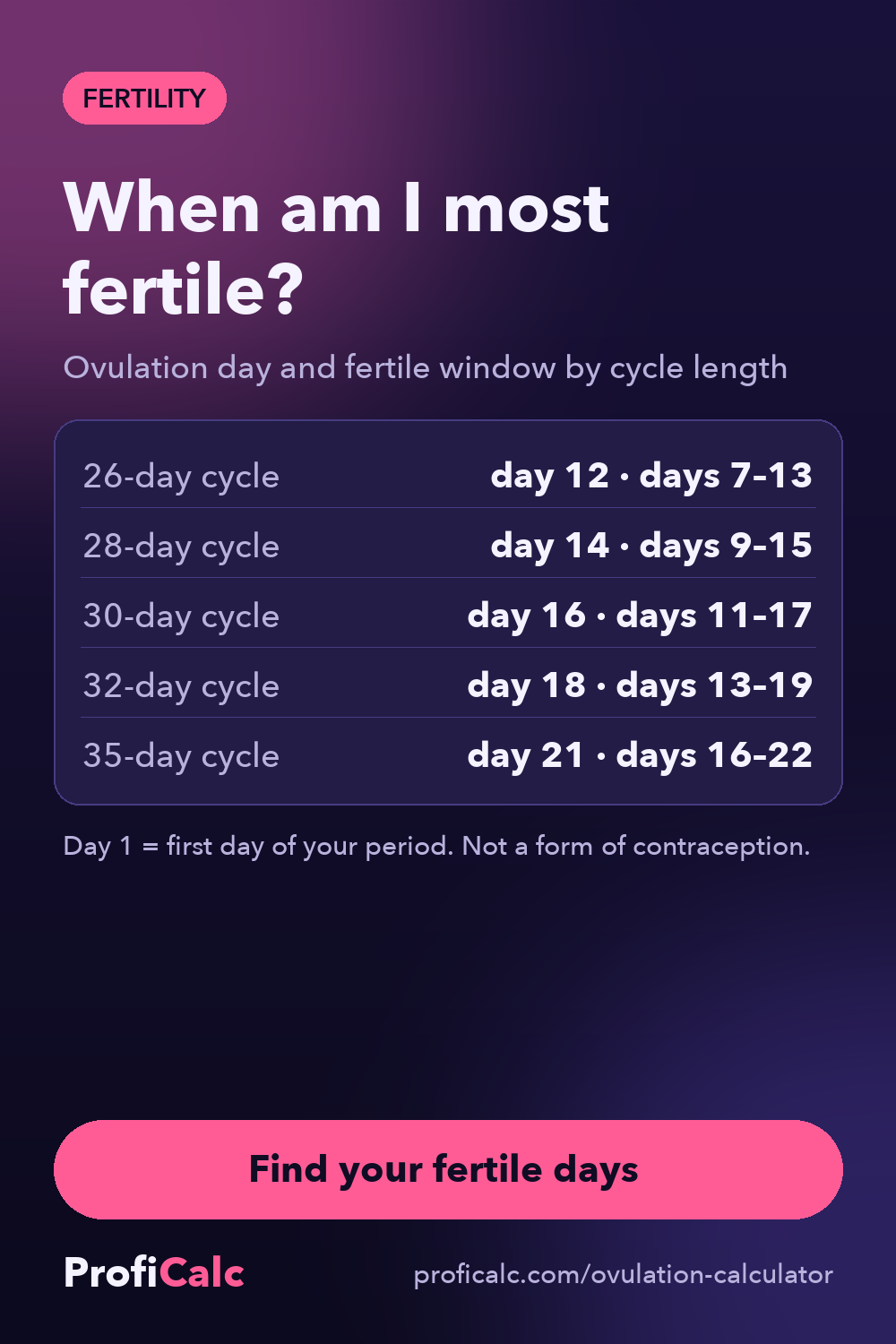
Ovulation usually happens about 14 days before your next period, not 14 days after your last one. The time between ovulation and your period (the luteal phase) is fairly constant at 12–16 days for most people, while the first half of the cycle varies. So the calculator works backwards:
- Next period = first day of last period + cycle length
- Ovulation = next period − luteal phase (14 days by default)
- Fertile window = 5 days before ovulation to 1 day after
Worked example
Your last period started on 1 June and your cycles are 30 days long. Your next period is due on 1 July (1 June + 30 days). Ovulation is likely around 17 June (1 July − 14 days), and your fertile window runs from about 12 to 18 June. The best days to try are 15–17 June.
Why the fertile window is six days
Sperm can survive in the reproductive tract for up to five days, but an egg lives only 12–24 hours after it's released. So sex in the five days before ovulation and on the day itself can lead to pregnancy. The chances are highest in the two days before ovulation and on ovulation day.
Signs of ovulation
- Cervical mucus becomes clear, slippery and stretchy, like raw egg white.
- Basal body temperature rises by about 0.2–0.5 °C (0.4–1 °F) after ovulation and stays up until your period.
- Ovulation tests (LH strips) detect the hormone surge 24–36 hours before ovulation.
- Some people notice mild one-sided pain (mittelschmerz) or breast tenderness.
Irregular cycles
If your cycle length changes by more than a week from month to month, a calendar prediction is much less reliable. Track your cycles for a few months, use ovulation tests, or talk to a doctor. Conditions such as PCOS and thyroid problems can affect ovulation.
When to take a pregnancy test
Home tests detect the hormone hCG, which starts rising after implantation, about 6–12 days after ovulation. For a reliable result, test on or after the day your period is due. Testing earlier can give a false negative.
Important: this calculator is not a form of contraception. Ovulation can shift from cycle to cycle, so don't rely on it to avoid pregnancy.
This calculator gives general information only and is not medical advice. Talk to a doctor, midwife or registered dietitian about your own health.
Frequently asked questions
When am I most fertile?
In the two days before ovulation and on ovulation day itself. For a 28-day cycle, that's usually around days 12–14, counting the first day of your period as day 1.
How long after my period do I ovulate?
With a 28-day cycle, about 14 days after your period starts. With a 35-day cycle, about day 21. It depends on your cycle length.
Can I get pregnant outside the fertile window?
It's unlikely but possible, because ovulation can come earlier or later than predicted. Don't use the calculator as contraception.
How accurate are ovulation calculators?
They're a good estimate for regular cycles. Ovulation tests and basal body temperature tracking are more accurate.
When should I take a pregnancy test?
On or after the first day of your missed period gives the most reliable result.