What are macros?
Macronutrients, or macros, are the three nutrients that provide calories: protein and carbohydrates at 4 kcal per gram, and fat at 9 kcal per gram. (Alcohol has 7 kcal per gram but isn't counted as a macro.) Counting macros means aiming for a set number of grams of each, not just a calorie total.
How the macro calculator works
- It estimates your maintenance calories with the Mifflin-St Jeor equation and your activity level, the same way as our calorie calculator.
- It adjusts for your goal: about 500–550 kcal less to lose weight, or 250–275 kcal more to build muscle.
- It splits those calories between protein, carbs and fat using the diet style you pick, then divides by 4 or 9 to turn calories into grams.
Worked example
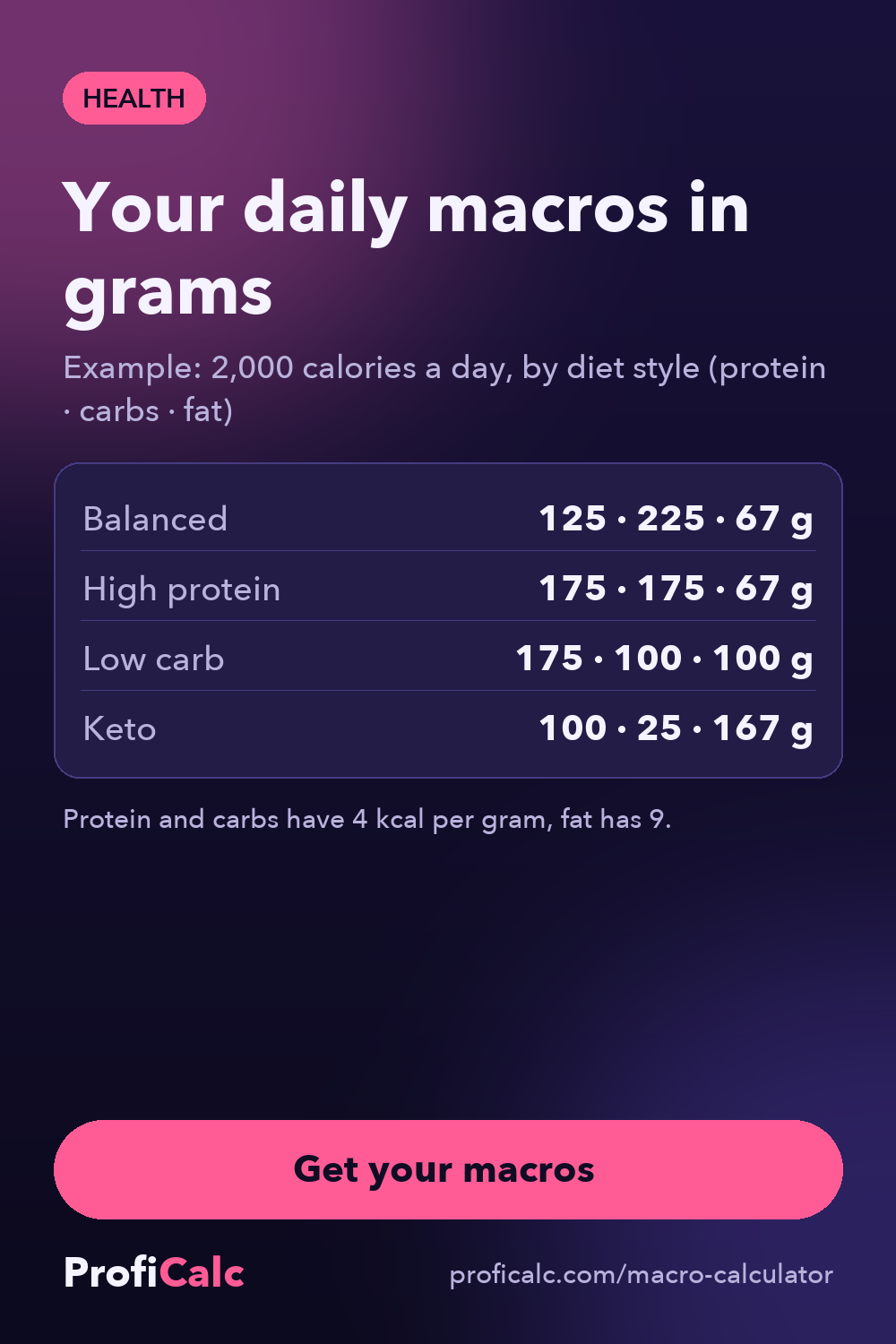
Daily target of 2,000 kcal with the balanced split (25% protein, 30% fat, 45% carbs):
- Protein: 2,000 × 0.25 ÷ 4 = 125 g
- Fat: 2,000 × 0.30 ÷ 9 = 67 g
- Carbs: 2,000 × 0.45 ÷ 4 = 225 g
Which diet style should I pick?
- Balanced: sits inside the ranges most health bodies recommend (10–35% protein, 20–35% fat, 45–65% carbs). A good default.
- High protein: helps you stay full and keep muscle while losing weight, or build it with strength training.
- Low carb: some people find it easier to control appetite this way. Total calories still matter most for weight.
- Low fat: suits people who prefer starchy foods, or endurance athletes who need lots of carbs.
- Keto: very low carb (usually under 50 g a day) to push the body into ketosis. It's restrictive; check with a doctor first if you have diabetes, kidney problems or take medication.
How much protein do you need?
The minimum recommended intake for adults is 0.8 g per kg of body weight a day. People who exercise regularly, older adults and anyone losing weight usually do better on 1.2–2.0 g per kg. The calculator shows your protein per kg so you can check it falls in that range. Spreading protein over 3–4 meals with 20–40 g each helps your body use it for muscle.
Tips for hitting your macros
- Build each meal around a protein source (meat, fish, eggs, dairy, tofu, beans), then add carbs and fats.
- Weigh food for a week or two to learn what portions look like.
- Being within about 10 g of each target is plenty accurate.
This calculator gives general information only and is not medical advice. Talk to a doctor, midwife or registered dietitian about your own health.
Frequently asked questions
How do I calculate my macros?
Work out your daily calories, choose a percentage split, then divide: protein and carb calories by 4, fat calories by 9, to get grams. The calculator above does all three steps.
What is the best macro ratio for weight loss?
Any ratio works if you're in a calorie deficit, but higher protein (25–35% of calories) makes it easier to stay full and keep muscle.
How many grams of protein should I eat a day?
At least 0.8 g per kg of body weight. If you exercise or are losing weight, 1.2–2.0 g per kg is a common target: about 85–140 g a day for a 70 kg adult.
Are macros more important than calories?
Calories decide whether you gain or lose weight. Macros affect how full you feel, how much muscle you keep and your energy for training.
What are keto macros?
Typically about 70–75% of calories from fat, 20–25% from protein and 5% (often under 20–50 g) from carbs.